The Gender Pay Gap report is calculated based on the mandatory Snapshot Date which, for Scottish Rugby, is 5th April 2025. The Mean and Median Gender Pay Gap calculations are defined as follows, and the earnings used to calculate the rate of pay include salary, allowances and any bonuses paid within the month that the Snapshot Date falls. However, the Gender Bonus Gap calculations also include bonuses paid in the full year prior to the Snapshot Date.
*Mean pay gap: The mean pay gap compares the average pay of men and women by adding up each group’s pay and dividing by the number of people in each group.
*Median pay gap: The median pay gap compares the middle earning man and woman when all pay values are lined up from lowest to highest.
Our Gender Pay Gap Report is not a measure of Equal Pay and does not compare specific roles. Our approach to equal pay, which is embedded within all our employment practices, ensures that men and women receive comparable pay for comparable roles. Scottish Rugby is committed to ensuring all our people are paid fairly and appropriately for the work they do.
Our Gender Pay Gap continues to be significantly influenced by the structure of our workforce, particularly the inclusion of professional male players and performance-related bonuses linked to the Men’s Six Nations included within the annual snapshot period.
While the mean pay and bonus gaps have reduced this year, our median measures have increased, reflecting the ongoing impact of how employees are distributed across different pay quartiles.
We remain committed to long-term actions to improve representation and pay balance across the organisation, whilst recognising that differences in income generation between the male and female professional games, reflected in player salary levels, will continue to influence overall pay outcomes in the near term.
The information below relates to all our employees (i.e. it includes all players and coaches).
Mean and Median gaps for Pay and Bonus
| Year | Mean Pay Gap | Median Pay Gap | Mean Bonus Gap | Median Bonus Gap |
| 2025 | 53% | 26% | 78% | 86% |
| 2024 | 58% | 18% | 86% | 69% |
Compared to 2024 figures, the Mean Pay Gap has decreased to 53% in 2025, from 58% in 2024. However, the Median Pay Gap has increased to 26% from 18%.
The 2025 figures above show the Mean Bonus Gap has decreased from 86% to 78%, and the Median Bonus Gap has increased to 86% from 69%.
We engage a population of flexible hours workers to support our large scale events. In the snapshot month of April 2025, a greater proportion of the flexible workers were female. These roles are typically in the lower quartile of earners. If this population of roles were excluded from the calculations, the median pay gap would reduce by 6% to 20% for 2025.
Percentage of employees receiving bonus payments
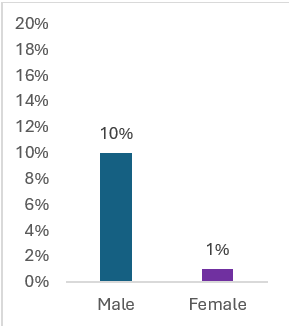
A greater portion of male employees received bonuses than their female counterparts. This was largely driven by performance related bonuses attributed to the Men’s Six Nations Championship.
Proportion of Males and Females in each quartile pay band.
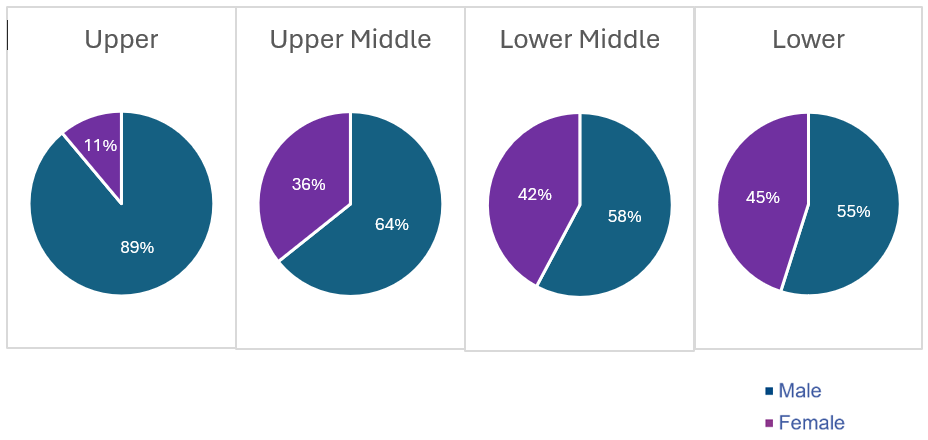
The 2025 report shows minor movements in the Gender Pay gap position by quartile groups from the 2024 figures. The Upper quartile sees an increase in the female population of 3%, to 11%, reflecting more women in the higher pay brackets than the previous year. The proportion of males in the upper middle has remained consistent at 64%. The Lower Middle has seen a 3% decrease in the female population to 42%, and the lower quartile has seen a decrease in male population from 63% to 55%.
The increase in female representation in the upper quartile reflects targeted progression and retention of senior female employees. However, overall representation remains low at 11%, highlighting the need for continued focus on our leadership recruitment and development practices and pathways.
Further Analysis
Scottish Rugby are obligated to publish pay and bonus data to report on differences between male and female employees, which includes all our people. In addition to the mandatory reporting, we have historically included a report that excludes professional players. This is in recognition of the market factors impacting earnings in the male professional game, including the differing stages of evolution of the male and female game.
The inclusion of professional male players, who are significantly higher paid than most of the rest of our workforce due to market dynamics—materially distorts the Gender Pay Gap. This impact is further amplified by the timing of Men’s Six Nations performance-related bonus payments falling within the snapshot period. When these roles are excluded, the mean pay gap reduces from 53% to 38%, demonstrating the extent of this structural impact and provides a more comparable view to other organisations without professional athlete populations.
Additionally, the Men’s Six Nations Championship fixtures are some of the biggest events held at Scottish Gas Murrayfield. Therefore, we see a spike in our flexible hours workforce operating at that time. With many of these individuals being paid in our Snapshot period, this further skews the pay gap.
Gender Pay Gap & Data excluding Players
It is widely recognised that the male professional game is further developed in its commercial evolution than the female game, generating bigger crowds, and greater revenues from sponsorship and broadcast. As a consequence of this, professional male players earn greater salaries than their female counterparts. Scottish Rugby is actively investing in the development of the women’s professional game, including a revised contracting model aimed at improving earnings, support structures, and long-term sustainability.
For information, when the Gender Pay and Bonus Gaps are calculated excluding professional players for 2025, the impacts compared to 2024 figures excluding professional players are:
- The Mean Gender Pay Gap reduces to 38% from 53%
- The Median Gender Pay Gap reduces to 26% from 29%
- The Mean Bonus Gap reduces from 78% to 55%
- The Median Bonus Gap reduces to 20% from 86%
When comparing 2025 figures to 2024, the portion of females in our pay quartiles is impacted as follows when calculated excluding professional players:
- Upper – increased to 16% from 11%
- Upper Middle – decreased to 33% from 39%
- Lower Middle – marginal change from 46% from 45%
- Lower – increase to 61% from 45%
Conclusion
Looking ahead, Scottish Rugby is committed to continuing to take clear steps to address the factors influencing the Gender Pay Gap. We will continue to focus on strengthening recruitment processes and talent development pipelines to support greater gender balance and continue to invest in the development of the women’s professional game. We will also review our bonus structures where appropriate and enhance transparency around pay and progression across the organisation. However, we recognise that, given the current differences in income generation and the resulting disparity in professional player salaries between the men’s and women’s games, these actions are unlikely to result in a significant shift in the overall Gender Pay Gap in the short term. Our priority remains ensuring that men and women are paid equally for like-for-like roles across the organisation, while continuing to take longer-term actions to support a more balanced pay profile over time.
I confirm that the calculations have been carried out accurately in accordance with The Equality Act 2010 (Gender Pay Gap Information) Regulations 2017.
Shona Bell
Chief People and Engagement Officer